1Empirisch Tech GmbH · 2Silicon Austria Labs GmbH
IEEE/CVF Winter Conference on Applications of Computer Vision · WACV 2027
Our controlled study of what makes a detector trained only in simulation hold up on a real factory floor has been accepted at WACV 2027.
The detector in the paper follows a strict zero-shot protocol. No real image informs training or the choice of threshold. It is then measured twice, on a real held-out test set and in a separate deployment on the factory floor.
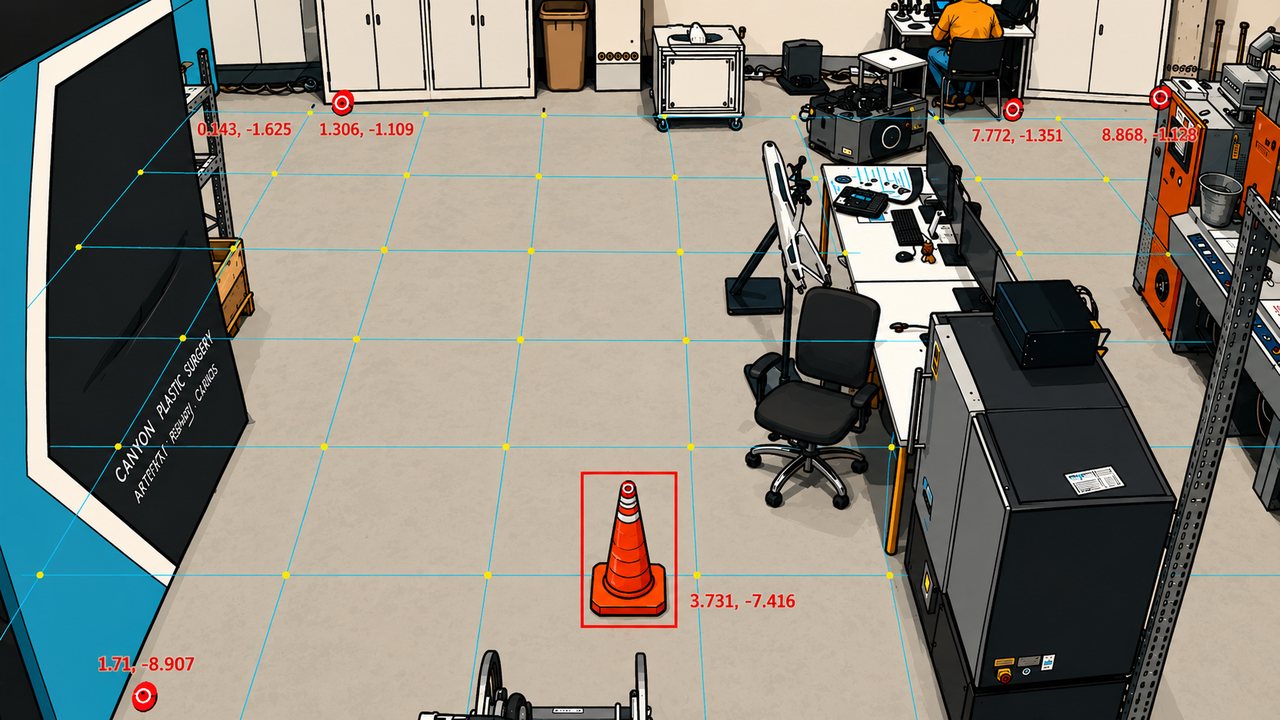
Training scenes are rendered with domain randomization in CARLA and Unreal Engine 5.5. The task is safety cone detection on a factory floor, a setting the simulator was never built for.
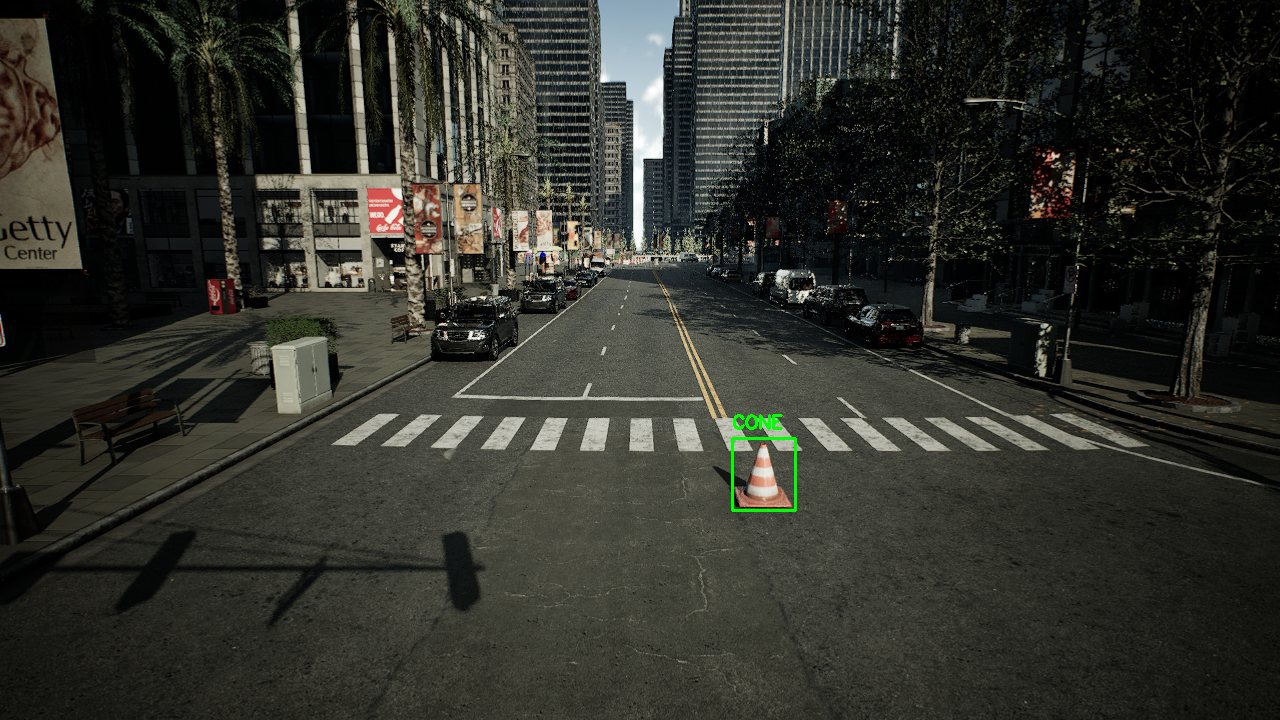
Training object detectors exclusively on synthetic data eliminates costly site-specific annotation. However, the design choices governing whether these detectors scale to the real world are often made without controlled comparison. This study provides a systematic evaluation of safety-cone detection for a factory-floor task, using scenes rendered with domain randomization in CARLA and Unreal Engine 5.5 and a strict zero-shot protocol in which no real image informs training or thresholding. Our findings identify annotation geometry as a key factor, with silhouette projection clearly outperforming bounding cuboids. A leave-one-out ablation of five randomization factors shows that transfer is object-centric, letting an outdoor driving simulator supervise an indoor task. Sweeping architecture against on-device latency shows that this tolerance is not universal, since lightweight backbones lose far more from frozen background randomization than heavier ones. Randomization and architecture must therefore be chosen jointly. The detector reaches 63.5% mAP@50-95 and 96.8% mAP@50 on a selected real held-out test set. In a separate in-situ deployment, it reaches 99.3% precision and 94.4% recall over 144 cone instances in 118 frames.
The design choices behind synthetic training are often made without a controlled comparison. This study makes that comparison for one industrial task and reports what carried over to real images.
How a 3D object becomes a 2D box is a key factor. Boxes projected from the object silhouette clearly outperform boxes projected from its bounding cuboid.
A leave-one-out ablation of five randomization factors shows that transfer is object-centric. That is what lets an outdoor driving simulator supervise an indoor task.
Sweeping architecture against on-device latency shows the tolerance is not universal. Lightweight backbones lose far more from frozen background randomization than heavier ones.
Randomization and architecture interact, so they have to be chosen jointly and not one after the other.
Four YOLOX checkpoints from the same line of work, released under Apache-2.0. Each one adds a traffic cone class to the 80 COCO classes, with the cone labels produced by a detector and not by annotators.
If the study is useful in your own research, please cite the WACV 2027 paper.
W. Masood, A. Hadziaganovic and R. Muzaffar. Design Choices for Zero-Shot Synthetic-to-Real Object Detection in Industrial Environments. IEEE/CVF Winter Conference on Applications of Computer Vision (WACV), 2027.
@inproceedings{masood2027designchoices,
title = {Design Choices for Zero-Shot Synthetic-to-Real Object Detection in Industrial Environments},
author = {Masood, Wasif and Hadziaganovic, Armin and Muzaffar, Raheeb},
booktitle = {IEEE/CVF Winter Conference on Applications of Computer Vision (WACV 2027)},
year = {2027},
url = {https://empirischtech.at/papers/synthetic-to-real-detection}
}
The pipeline studied in this paper is the one we run for customers. Your object is rendered, a detector is trained on the renders, and it goes live on your camera.