Paper accepted · WACV 2027

Design Choices for Zero-Shot Synthetic-to-Real Object Detection in Industrial Environments

1Empirisch Tech GmbH  ·  2Silicon Austria Labs GmbH

IEEE/CVF Winter Conference on Applications of Computer Vision · WACV 2027

Our controlled study of what makes a detector trained only in simulation hold up on a real factory floor has been accepted at WACV 2027.

01 / Headline results

No real image in training.
Scored on real ones.

The detector in the paper follows a strict zero-shot protocol. No real image informs training or the choice of threshold. It is then measured twice, on a real held-out test set and in a separate deployment on the factory floor.

mAP@50
96.8%
Detection accuracy on real images the detector never trained on.
Real held-out test set
mAP@50-95
63.5%
The same test set, averaged over stricter overlap thresholds.
Real held-out test set
Precision
99.3%
Measured over 144 cone instances in 118 frames.
In-situ deployment
Recall
94.4%
The same 144 cone instances in the same 118 frames.
In-situ deployment
All four figures are quoted from the abstract. The paper describes the test set as a selected real held-out set and reports the deployment separately from it.
02 / Setup

An outdoor driving simulator.
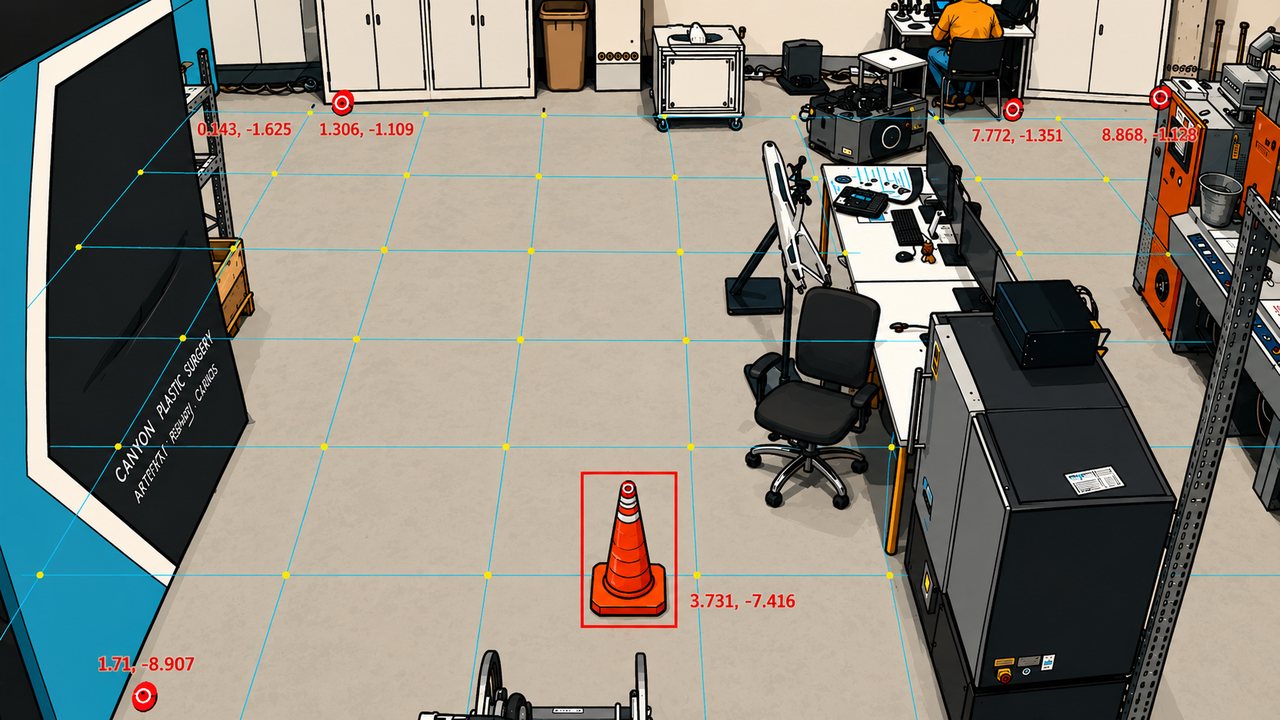
An indoor task.

Training scenes are rendered with domain randomization in CARLA and Unreal Engine 5.5. The task is safety cone detection on a factory floor, a setting the simulator was never built for.
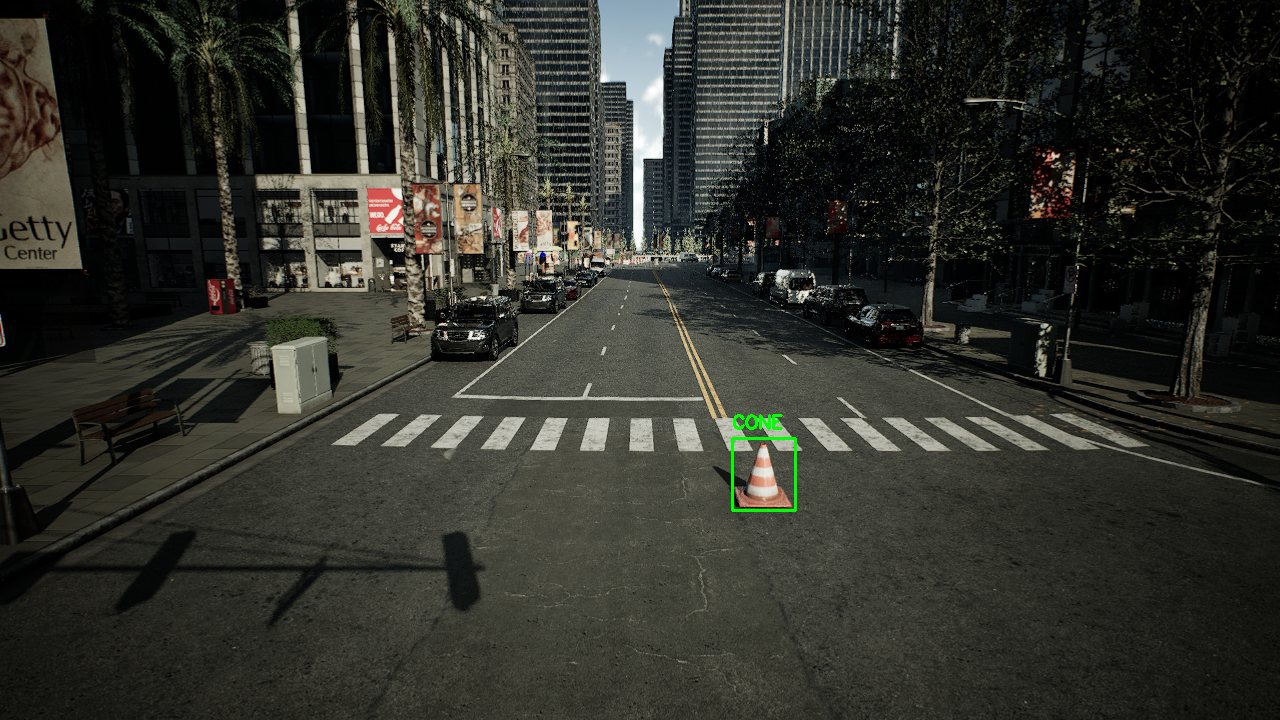
Rendered city street in the CARLA simulator with a traffic cone boxed in the road
Training domainRendered in simulation
Factory floor seen from a fixed camera with a floor coordinate grid and a detected cone boxed in red
Test domainReal factory floor
Simulator
CARLA and Unreal Engine 5.5, scenes rendered with domain randomization
Task
Safety cone detection for a factory floor
Protocol
Zero-shot. No real image informs training or thresholding
Evaluation
A real held-out test set, plus a separate in-situ deployment
The two frames come from the Simvera pipeline and the cone pilot. They illustrate the two domains and are not figures from the paper.
03 / Abstract

Abstract.

Training object detectors exclusively on synthetic data eliminates costly site-specific annotation. However, the design choices governing whether these detectors scale to the real world are often made without controlled comparison. This study provides a systematic evaluation of safety-cone detection for a factory-floor task, using scenes rendered with domain randomization in CARLA and Unreal Engine 5.5 and a strict zero-shot protocol in which no real image informs training or thresholding. Our findings identify annotation geometry as a key factor, with silhouette projection clearly outperforming bounding cuboids. A leave-one-out ablation of five randomization factors shows that transfer is object-centric, letting an outdoor driving simulator supervise an indoor task. Sweeping architecture against on-device latency shows that this tolerance is not universal, since lightweight backbones lose far more from frozen background randomization than heavier ones. Randomization and architecture must therefore be chosen jointly. The detector reaches 63.5% mAP@50-95 and 96.8% mAP@50 on a selected real held-out test set. In a separate in-situ deployment, it reaches 99.3% precision and 94.4% recall over 144 cone instances in 118 frames.

04 / Findings

What the study found.

The design choices behind synthetic training are often made without a controlled comparison. This study makes that comparison for one industrial task and reports what carried over to real images.

Annotation geometryFinding 01
Two ways to box the same cone A traffic cone inside a wireframe cuboid, seen from above and to one side. A loose dashed box encloses the projected cuboid and a tighter solid box encloses only the cone silhouette. CUBOID BOX loose SILHOUETTE BOX tight
Two ways to turn a 3D object into a 2D label. The dashed box bounds the projected cuboid, so it takes in empty background above the cone. The solid box bounds only the silhouette.Illustration by Simvera, not a figure from the paper
01 · Annotation geometry

Silhouettes beat cuboids.

How a 3D object becomes a 2D box is a key factor. Boxes projected from the object silhouette clearly outperform boxes projected from its bounding cuboid.

02 · Randomization

Transfer is object-centric.

A leave-one-out ablation of five randomization factors shows that transfer is object-centric. That is what lets an outdoor driving simulator supervise an indoor task.

03 · Architecture

Small backbones forgive less.

Sweeping architecture against on-device latency shows the tolerance is not universal. Lightweight backbones lose far more from frozen background randomization than heavier ones.

04 · Conclusion

Choose both together.

Randomization and architecture interact, so they have to be chosen jointly and not one after the other.

05 / Open models

The YOLOX-Pylon family,
open on Hugging Face.

Four YOLOX checkpoints from the same line of work, released under Apache-2.0. Each one adds a traffic cone class to the 80 COCO classes, with the cone labels produced by a detector and not by annotators.

Scores come from the model cards, measured on COCO val2017 plus a held-out cone split at 640×640. Inference is forward pass plus NMS at batch 1 on an NVIDIA A100. These checkpoints are trained on COCO imagery, so they are a separate result from the zero-shot detector evaluated in the paper.
06 / Cite

Cite this work.

If the study is useful in your own research, please cite the WACV 2027 paper.

W. Masood, A. Hadziaganovic and R. Muzaffar. Design Choices for Zero-Shot Synthetic-to-Real Object Detection in Industrial Environments. IEEE/CVF Winter Conference on Applications of Computer Vision (WACV), 2027.

BibTeX
@inproceedings{masood2027designchoices,
  title = {Design Choices for Zero-Shot Synthetic-to-Real Object Detection in Industrial Environments},
  author = {Masood, Wasif and Hadziaganovic, Armin and Muzaffar, Raheeb},
  booktitle = {IEEE/CVF Winter Conference on Applications of Computer Vision (WACV 2027)},
  year = {2027},
  url = {https://empirischtech.at/papers/synthetic-to-real-detection}
}

Have an object no dataset covers?

The pipeline studied in this paper is the one we run for customers. Your object is rendered, a detector is trained on the renders, and it goes live on your camera.

Apply for Demo →